

Understanding road freight costs in New Zealand starts with looking at everything needed to deliver a dependable service. Diesel is part of that picture, alongside skilled drivers, vehicles, maintenance, road user charges and the systems that keep the work and team organised. A freight rate needs to account for those resources as well as the particular load, route and delivery requirements. Knowing what sits behind the price helps you understand a quote and ask useful questions about the service it covers.
At Campbells Cartage, our approach is to manage those costs carefully, plan the work efficiently and explain the charges before your freight moves. For customers, fair pricing depends on both a sound calculation and a shared understanding of what has been agreed. That includes how fuel adjustments are applied, what other charges may arise and how changes to the work will be discussed.
Why freight costs go beyond the fuel tank
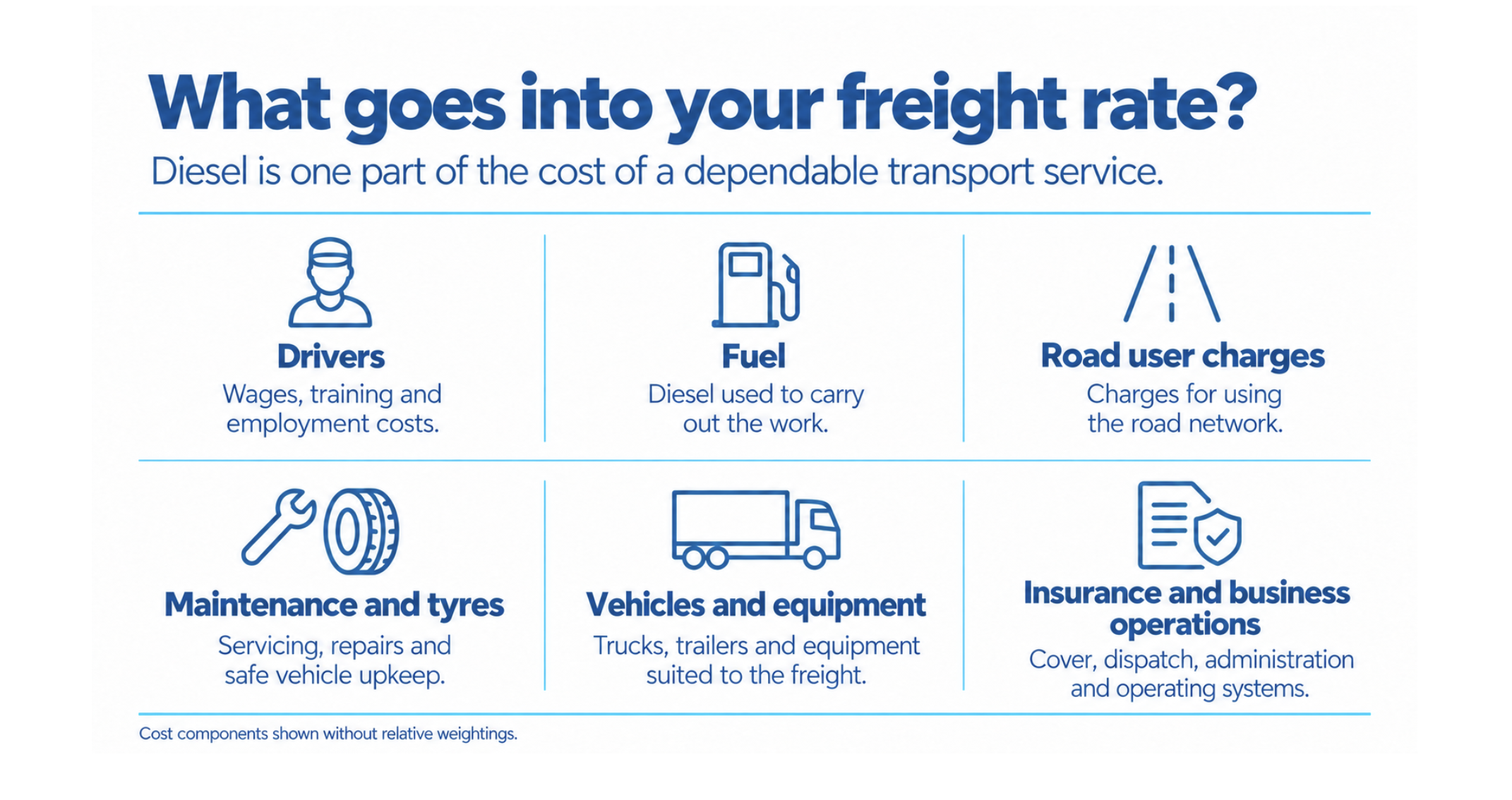
New Zealand’s transport industry is exposed to local and international costs. Wages, road charges and domestic services sit alongside imported fuel, trucks, tyres and replacement parts. Exchange rates add another influence: Reserve Bank research explains how changes in the New Zealand dollar can affect import prices. For a transport operator, overseas price movements can therefore reach the workshop as well as the fuel tank, although their timing depends on purchasing arrangements, stock and replacement cycles.
These inputs do not all move together, which helps explain why freight rates and diesel prices do not necessarily rise or fall by the same amount. Fuel may become cheaper while repairs, insurance or other operating expenses increase. A fuel-price change affects one part of the overall cost, rather than changing every expense involved in running a vehicle and completing a delivery. Its effect on the freight rate therefore needs to be considered in proportion to fuel’s share of the total.
The Transporting New Zealand–Grant Thornton Transport Cost Index tracks a weighted basket of road freight operating expenses, including wages, fuel, repairs, tyres, insurance and overheads. It offers an industry reference for understanding the broader cost picture, although it does not determine the price of an individual job. Each operator’s costs still depend on its vehicles, routes and type of work. The service being quoted and the resources it requires remain central to understanding the price.
How fuel adjustments affect your freight quote
For customers, understanding how fuel adjustment factors work makes it easier to see which part of a freight charge responds to diesel prices. A fuel adjustment factor, or FAF, accounts for fuel movements separately from the base freight rate. It typically compares a reference fuel price with an agreed base price and applies a formula reflecting fuel’s contribution to transport costs. The adjustment is commonly expressed as a percentage of the applicable freight charge, with the method and review period depending on the provider and customer agreement.
Transporting New Zealand’s fuel calculators illustrate how diesel-price changes can be assessed against operating costs and contractual fuel-adjustment arrangements. At Campbells, our approach is to review FAF monthly using the previous month’s average fuel price, subject to the agreed customer terms. This means an adjustment can lag behind a change at the pump: a monthly average reflects a period of purchasing rather than one day’s price. As the reference price changes, the adjustment should respond according to the agreed formula.
A clear commercial freight quote should make that calculation understandable alongside the rest of the service. It should identify the work being priced, the base charge, applicable FAF and GST, and any additional charges and the circumstances in which they apply. Customers should be able to understand which charges the FAF applies to, the percentage being used and its effect on the invoice. These details make it easier to compare what is included in a price and avoid assumptions about the final charge.
Our approach is to make those terms clear before work begins. If the scope changes, the pricing implications should be discussed promptly so the customer has the information needed to decide how to proceed. That conversation might involve a different load, a revised collection point or changed delivery requirements. The important point is that the price and the service remain connected, with both parties understanding what has changed and what is now being agreed.
How planning and maintenance support lasting value
Managing our own operation efficiently is equally important. For regular freight services, we consider how collections and deliveries fit together, match vehicles to the load and look for opportunities to reduce unnecessary travel. Where timing, capacity and freight requirements align, combining movements or arranging return freight can make better use of a journey. The opportunity depends on the work available in each direction, so it needs to be assessed against the route and the service promised to each customer.
Preparation also affects how smoothly a job runs. We plan how freight will be loaded, secured and unloaded, taking account of the vehicle, delivery sequence and equipment required. Dispatch and drivers need accurate information so they can coordinate the work safely and respond if something changes. Our responsibility is to bring those details together and communicate clearly, helping avoid unnecessary handling, travel or disruption while making effective use of the resources committed to the job.
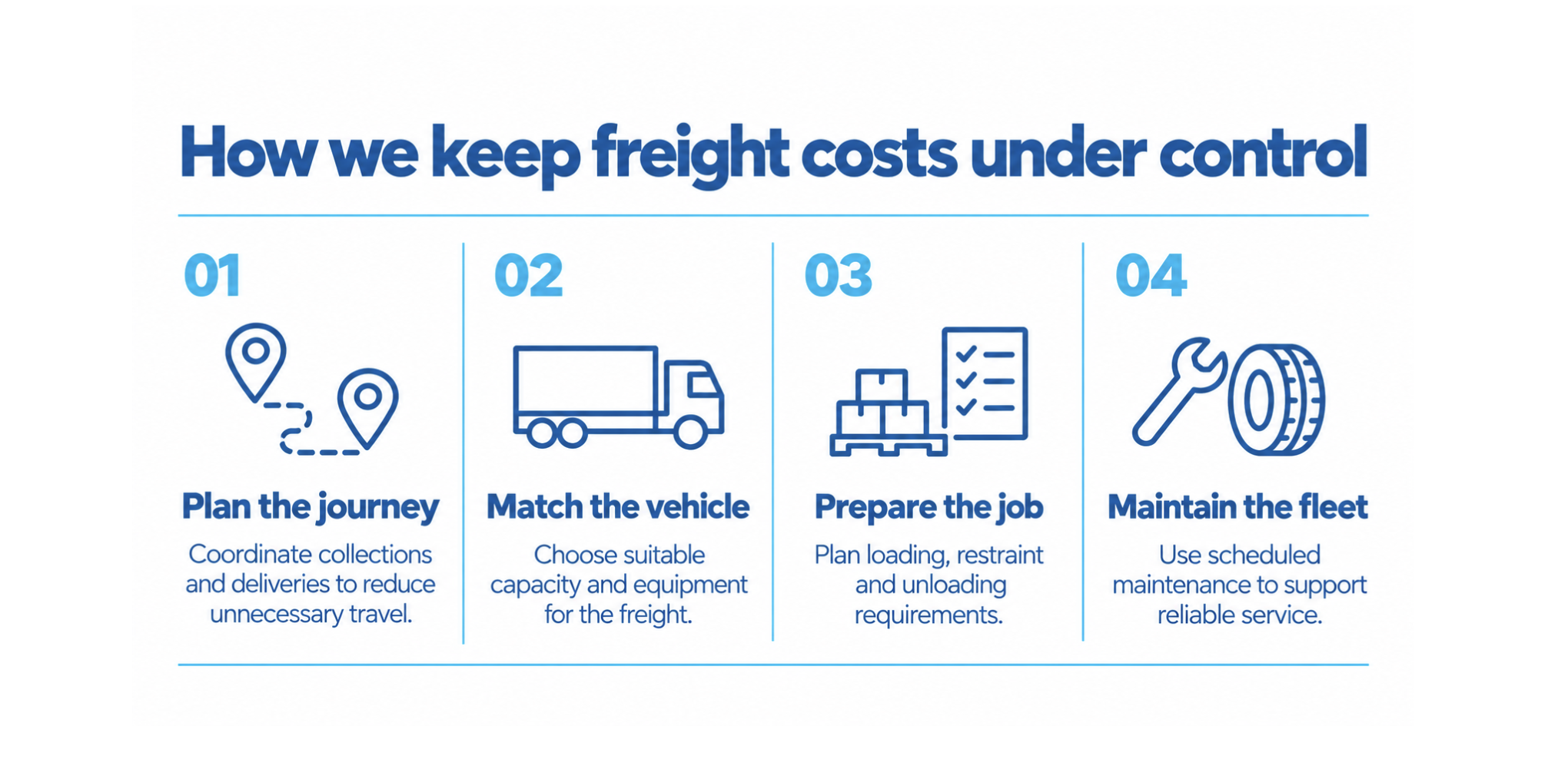
Purchasing and maintenance decisions require the same discipline. We negotiate with suppliers and consider price alongside suitability, quality, reliability and operating life. A cheaper component or a deferred service can prove expensive if it contributes to a breakdown. Planned maintenance and appropriate fleet investment help protect vehicle availability, giving customers greater confidence that the capacity they have booked will be ready. Those decisions are part of managing the cost of a dependable service over time.
The result we work towards is pricing you can understand and a service you can rely on. That means explaining fuel adjustments, being upfront about charges and taking responsibility for efficiency within our own business. Diesel will continue to influence freight costs, but lasting value also depends on how well the whole operation is managed. If you have regular freight to move, Rex can work through your load, route, timing and site requirements before confirming how Campbells can help.
