

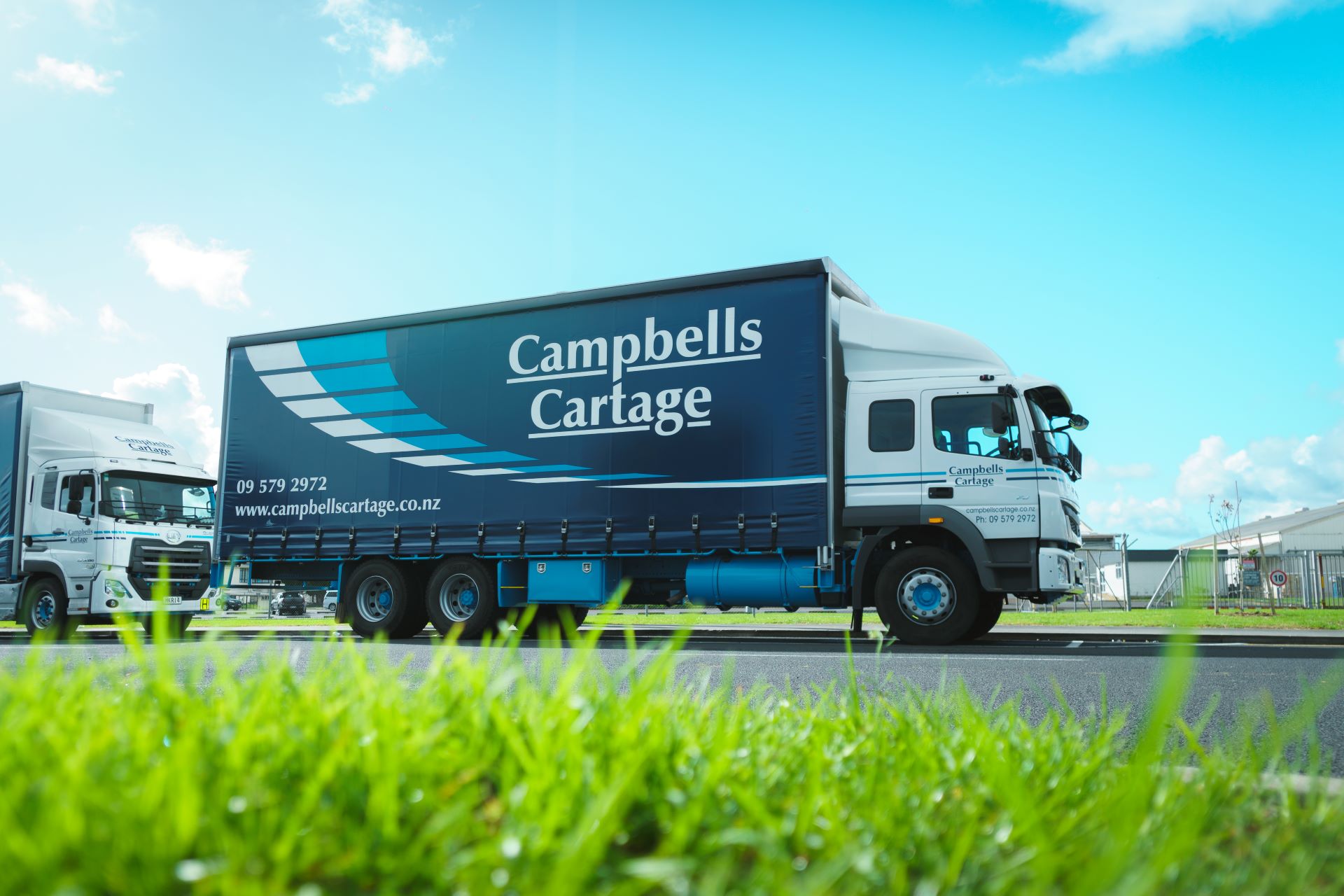
Reducing road freight emissions in New Zealand starts with understanding the work behind each journey: the fuel used, the freight carried and the distance travelled. Heavy trucks keep businesses supplied and goods moving, so practical improvements need to support a dependable service as well as a smaller environmental footprint. For customers, understanding how that footprint is calculated also makes it easier to ask useful questions about their transport provider’s progress.
At Campbells Cartage, we use fuel, job and vehicle information to guide improvements in daily operations and assess future fleet investment. That information helps connect environmental decisions with the work our customers need completed. Our focus is on understanding where change is possible, assessing whether it suits the operation and keeping a clear distinction between an improvement being considered and a result supported by evidence.
Understanding how freight emissions are calculated
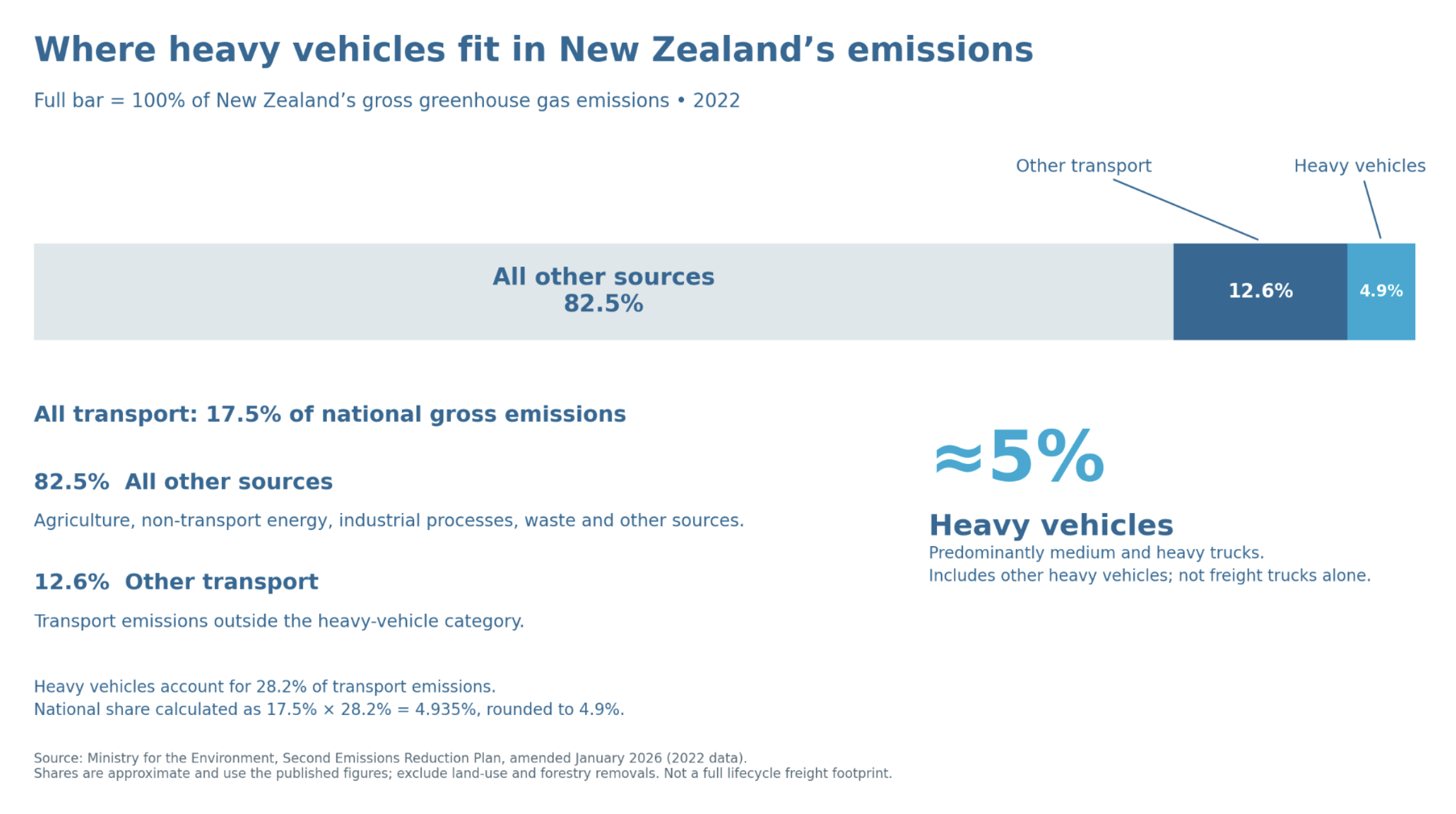
The Government’s second emissions reduction plan reports that transport accounted for 17.5% of New Zealand’s gross greenhouse gas emissions in 2022. Heavy vehicles produced 28.2% of that transport total, equivalent to approximately 4.9% of national gross emissions. The heavy-vehicle category includes vehicles other than freight trucks, so it should not be treated as a figure for commercial freight alone. These numbers provide national context rather than a measure of any one operator’s performance.
New Zealand’s national commitments aim to reduce net greenhouse gas emissions to 50% below gross 2005 levels by 2030, followed by 51–55% below gross 2005 levels by 2035. These targets establish a wider direction; they do not require every transport operator to achieve the same percentage reduction. For an individual business, the starting point remains understanding its own contribution and the practical changes it can make.
For a diesel fleet, fuel records provide a basis for estimating emissions by multiplying litres consumed by an appropriate fuel emissions factor. Our Transport Management System records job information, while EROAD provides information about vehicle movements. Together with fuel records, these help us understand fleet activity, including travel to collections, loaded journeys and empty running. Looking at the whole operation matters because a truck can consume fuel before goods are collected and after they have been delivered.
For customers asking how to calculate freight emissions, the question is more specific: what share relates to moving their goods? Where fuel use cannot be reliably attributed to a consignment, the Ministry for the Environment’s freight guidance provides average factors. One approach multiplies freight weight by distance to give tonne-kilometres, then applies a suitable factor. The example below uses the Ministry’s 2026 “all trucks” average of 0.135 kg CO₂-e per tonne-kilometre.
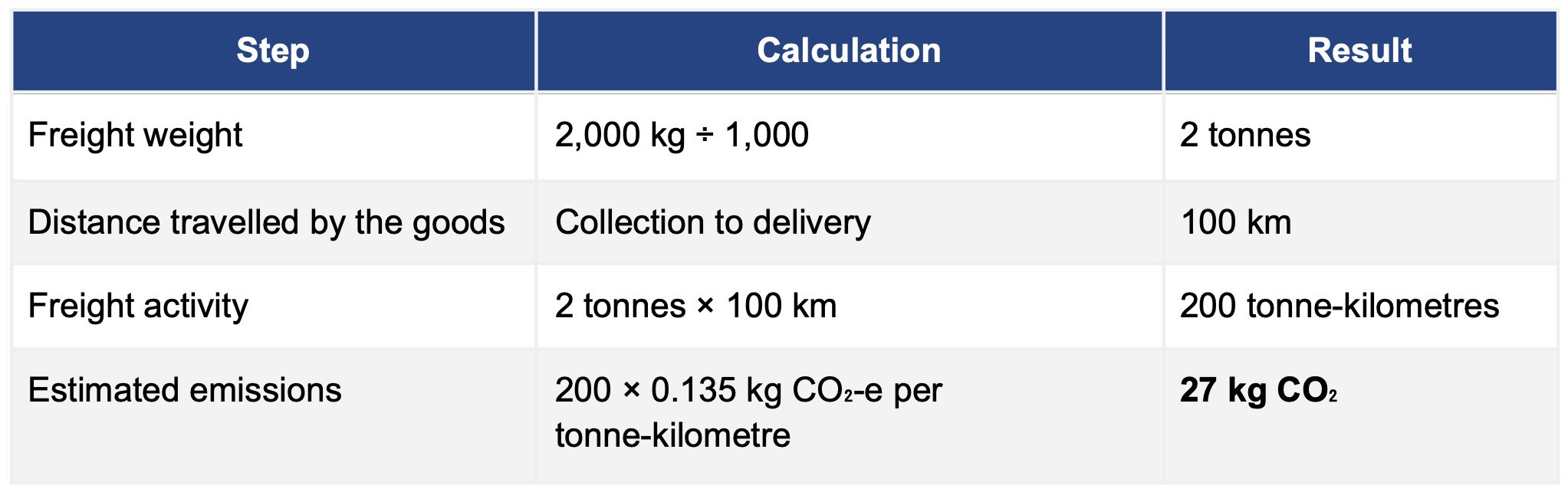
This is an illustration using a national average, not a measurement of a Campbells delivery. CO₂-e means carbon dioxide equivalent, a common measure of greenhouse gases’ warming effect. The appropriate factor depends on the service: the all-trucks average represents a mix of vehicle types and is not automatically suitable for every job. An estimate should make its method and assumptions clear so the result can be understood in context.
Shared loads also need consistent allocation. A customer should receive an appropriate share of relevant emissions, rather than the whole truck’s total. The method must account for assumptions already built into a published factor, including empty running, to avoid counting the same activity twice. Estimates based on national averages will not necessarily add up to the operator’s fuel-based total, because the methods use different information.
Turning operating information into practical improvements
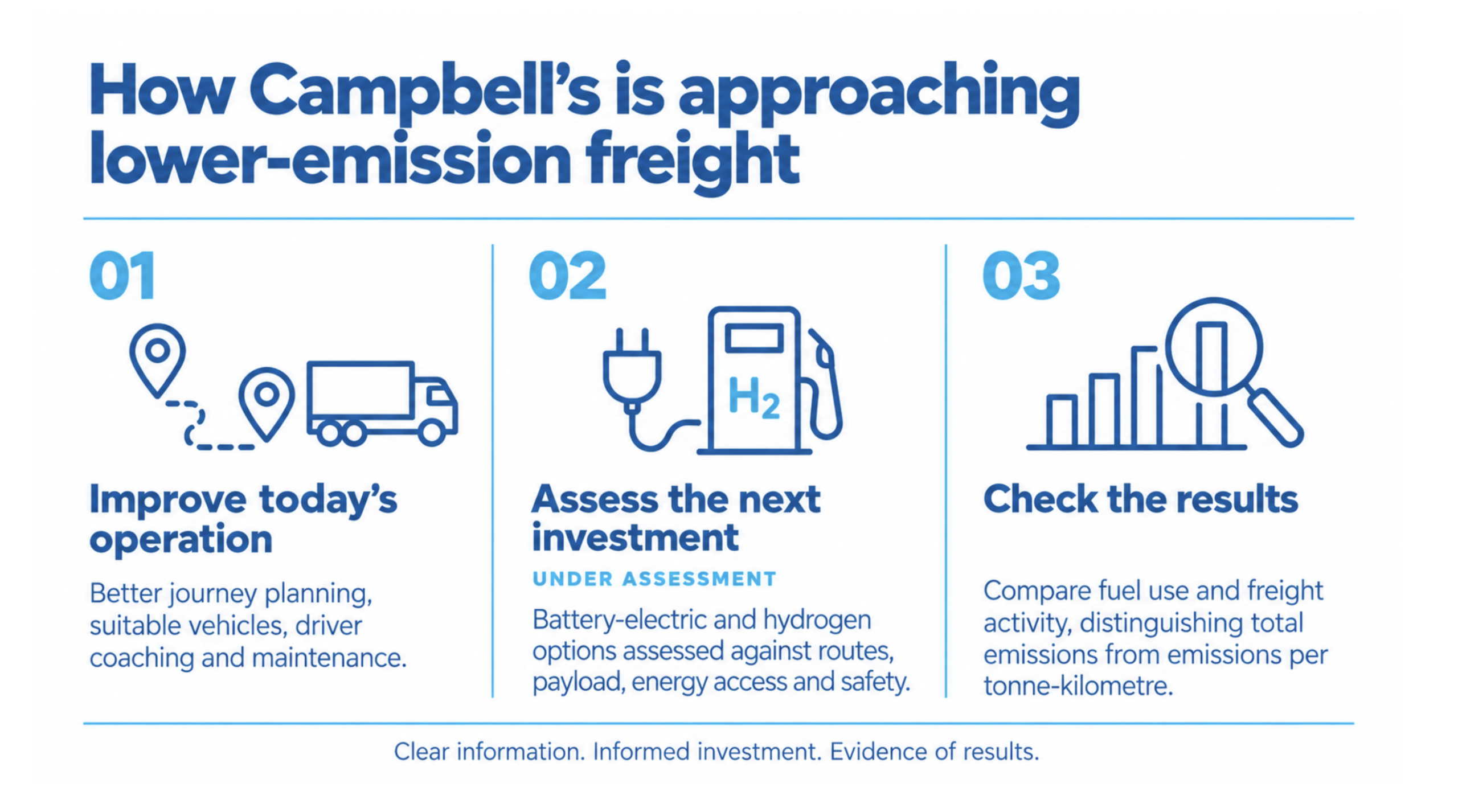
Our first opportunities lie in how we plan and carry out our commercial freight services. Matching vehicles to loads, coordinating collections and deliveries, and making effective use of capacity can reduce unnecessary travel. Suitable return freight can improve the use of a journey, although any additional distance needs to be considered. Loading and delivery order also matter: good preparation supports efficient movement while keeping handling, site requirements and safe delivery central to the plan.
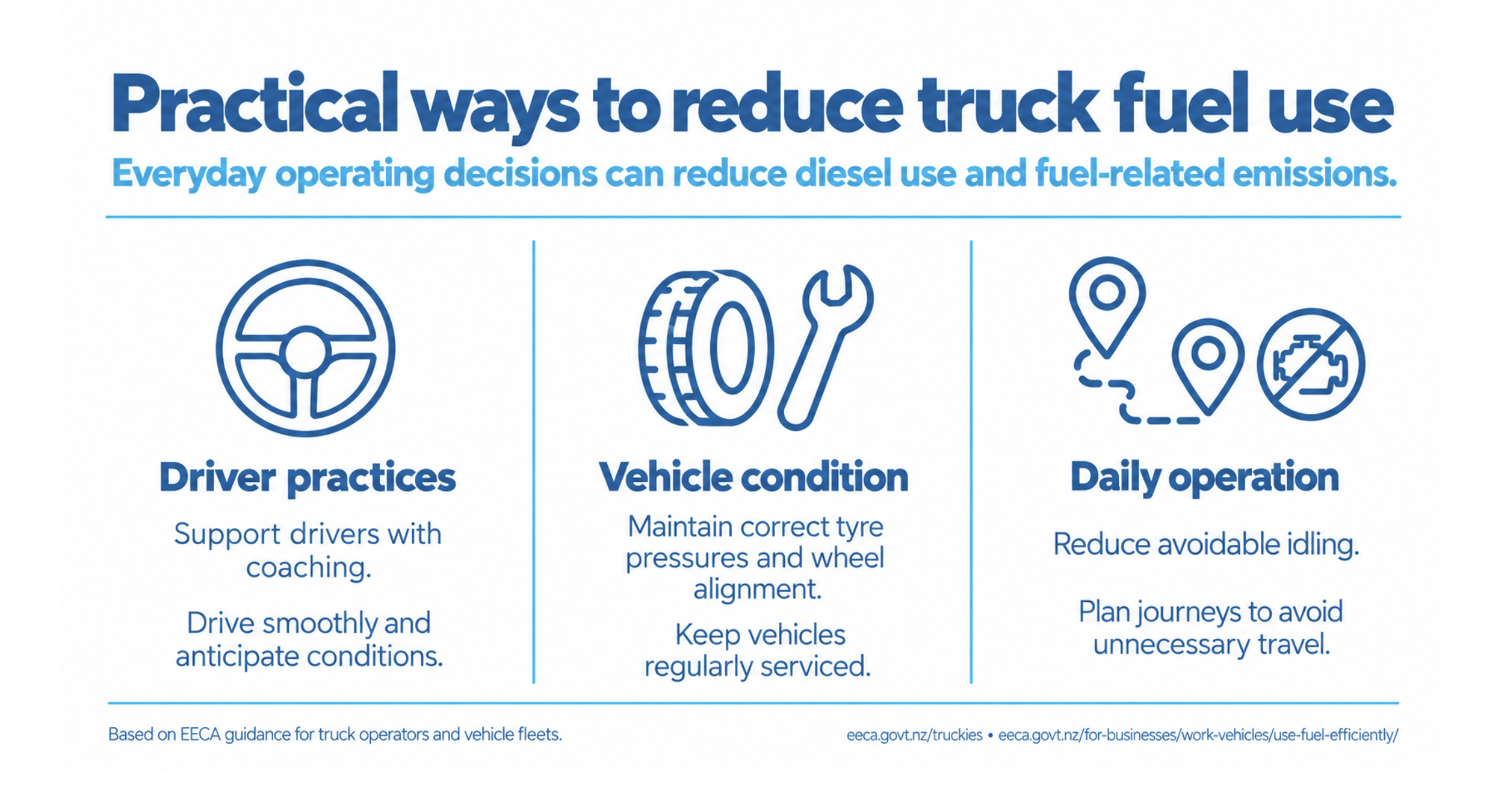
Drivers bring practical knowledge of the loads, routes and conditions behind the operating figures. Reviewing that information together helps identify ways to improve truck fuel efficiency without overlooking the circumstances of a job. EECA’s guidance for truck operators identifies driver training, reducing avoidable idling, correct tyre pressures, wheel alignment and maintenance as useful areas of attention. These are everyday practices that can reduce diesel use while supporting reliable vehicle operation.
Fleet renewal adds another opportunity, with different benefits to assess. Our fleet includes Euro V and Euro VI trucks, and staged replacement forms part of our planning. As the Ministry of Transport explains, Euro VI standards address harmful exhaust pollutants such as nitrogen oxides and particulates. That supports better air quality, but the rating alone does not demonstrate lower carbon emissions. Fuel consumption and the work performed still need to be considered when assessing that outcome.
We are also assessing battery-electric vehicles as part of planning for lower-emission freight transport. Payload, range, charging access, safety and lifetime cost all affect whether a vehicle can provide the service our customers need. Looking at these requirements early gives us time to understand which work a different vehicle could undertake and what infrastructure would be needed. Assessment is a step towards an informed decision; it is not a commitment to a purchase or a claim that reductions have already been achieved.
Investment also needs to be commercially workable. Immediate operating pressures can limit the pace of change, while vehicles may remain in service for many years. Our aim is to make decisions that provide lasting operating and environmental benefits. For customers, that means assessing new technology alongside the capacity, reliability and safety required to keep their freight moving, with a clear view of how the proposed vehicle would fit the work.
Reporting progress customers can understand
Customers reviewing Scope 3 freight emissions need to understand how their reporting relates to their provider’s. Diesel burned in vehicles we own or control generally forms part of our direct emissions, known as Scope 1. A customer may include its associated freight emissions in Scope 3, within its supply-chain footprint. The GHG Protocol recognises this overlap between businesses’ reports: the same activity is viewed from different responsibilities, so the figures should not be added together as separate physical emissions.
Useful reporting explains which activities are included, how the figures were calculated and whether they are estimates or independently verified results. Our job and vehicle information supports discussions about the records available for that work. Allocating a share of emissions to a customer does not remove those emissions from our own footprint; we remain responsible for understanding the operation as a whole and identifying where we can improve it.
Tracking fuel consumption, distance and freight activity over consistent periods helps show what has changed. A fall in total emissions may reflect less work, while more efficient operation can reduce emissions per tonne-kilometre even as total freight volumes grow. Considering both total emissions and emissions relative to the work performed gives a clearer picture. Our aim is to improve year on year and build a record of decisions, completed actions and results that the available evidence supports.
Independent verification can add confidence where its scope is clear, and we assess its value alongside investment in vehicles, infrastructure and operational improvements. The same care applies to what we say publicly. The Commerce Commission’s environmental claims guidance calls for accurate, specific and substantiated claims. Customers should be able to distinguish technology under assessment, investment committed and reductions achieved, and understand what any assessment actually covers.
For Campbells, progress means bringing these activities together: understanding the work, making practical improvements and checking what the results show. If you have regular freight requirements and sustainability priorities, Rex can discuss your operation and the information you need from a transport provider. That conversation provides a starting point for planning dependable service and understanding what can be supported by the records available.
Talk to the Campbells team about your regular freight requirements
